
5 Ways to Build Speed, Strength, and Athleticism Beyond Team Practice
Your athlete goes to practice several times a week. They play games on the weekends. Maybe they're even getting extra work with a private skills coach.
But when you watch them compete, you notice something.
They're a step behind getting to the ball. They're struggling to keep up with faster opponents. Or they have the skills to make a play, but they can't quite get their body into position to execute.
As a parent, you start wondering: How do I help my athlete get faster, stronger, and more athletic?
After more than 20 years of training athletes, from young kids just learning their sport to professionals competing at the highest levels, I can tell you that athletic development is one of the most important—and often overlooked—parts of helping young athletes reach their potential.
And here's something I want every sports parent to understand:
Just because your athlete plays a sport doesn't mean they're getting the athletic development they need.
Team practices are important. But most coaches have limited time, and their priority is preparing the team to compete. That means a lot of practice time goes toward learning plays, improving sport-specific skills, and working on team concepts.
There's not always enough time to develop an individual athlete's speed, strength, agility, and overall athleticism.
That's where focused athletic development comes in.
The good news? Your athlete doesn't need an expensive training facility, hours of additional workouts, or a complicated program to start improving.
Here are five areas I encourage sports parents to focus on.
1. Improve Their First-Step Speed
When parents tell me they want their athlete to get faster, the first thing I want to know is what they mean by faster.
Are they struggling to run down a ball in the outfield? Are they getting beat off the line of scrimmage? Are they a step behind their opponent on defense?
Because in a lot of sports, the first few steps are more important than how fast an athlete can run over 40 yards.
Think about a basketball player trying to beat a defender to the basket. A soccer player accelerating toward a loose ball. A defensive back reacting to a receiver's route. Or a baseball player breaking out of the batter's box.
In each situation, the athlete who can accelerate quickly has an advantage.
That's why I put so much emphasis on developing first-step quickness and acceleration.
What parents can do: Practice short acceleration starts
Find an open area with enough room for your athlete to sprint safely.
Have your athlete:
Start in a balanced, athletic ready position.
Accelerate as quickly as possible for 5–10 yards.
Focus on driving forward with powerful, controlled steps.
Walk back and recover fully before repeating.
Start with 4–6 quality repetitions, adjusting for your athlete's age, experience, and training load.
The key is quality, not quantity. You want your athlete moving as fast as they can with good mechanics, not getting tired from running sprint after sprint.
Coach's tip: Don't turn speed training into conditioning. If your athlete is exhausted and slowing down, they're no longer practicing their best acceleration. Give them enough recovery between repetitions to produce a high-quality effort.
2. Build Age-Appropriate Strength
One of the biggest misconceptions I hear from sports parents is that strength training means putting young athletes in a weight room and having them lift heavy weights.
That's not what I'm talking about.
Strength development for youth athletes starts with learning how to control their own bodies.
Can your athlete squat with good technique? Can they maintain their balance on one leg? Can they land from a jump without their knees collapsing inward? Can they stabilize their body when stopping or changing direction?
Those are foundational movement skills that help athletes become stronger and more effective competitors.
Strength matters because it supports an athlete's ability to produce force, maintain body control, and execute movements efficiently.
A stronger basketball player may be better equipped to hold their position defensively. A stronger soccer player can better control their body when challenged for the ball. A baseball player needs strength and stability to support powerful rotational movements.
And in football, strength is important at virtually every position.
But the goal for younger athletes isn't to see how much weight they can lift. It's to develop a foundation they can continue building as they grow.
What parents can do: Start with bodyweight strength exercises
A few foundational movements include:
Bodyweight squats: Develop lower-body strength and control.
Reverse lunges: Challenge single-leg strength and balance.
Glute bridges: Strengthen the hips and posterior chain.
Planks: Build core stability and body control.
Push-ups: Develop upper-body strength, using an incline or other modification when needed.
For a beginner, start with one or two sets of a manageable number of controlled repetitions, with appropriate supervision.
Your athlete should be able to complete each movement with proper technique before increasing the difficulty.
Coach's tip: Don't rush to add weights or more repetitions. If your athlete can't control their body through a basic movement, that's where you need to start. Proper technique comes before resistance.
As athletes get older and develop the necessary movement skills, a properly supervised strength program can progress to additional resistance.
3. Develop Agility and Body Control
Speed is important. But being fast in a straight line is only part of being a good athlete.
In most sports, athletes are constantly being asked to accelerate, stop, change direction, and react to what's happening around them.
That's where agility and body control come into play.
Think about a running back making a cut to avoid a defender. A basketball player closing out on a shooter and then reacting to a drive. A soccer defender adjusting to an opponent changing direction.
These movements require more than straight-line speed.
An athlete needs the strength and coordination to decelerate, control their body, and accelerate in a new direction.
And here's something parents often overlook: An athlete who can't slow down and control their body is going to struggle to change direction efficiently.
That's why agility training should include learning how to stop and change direction, not just running quickly through cones.
What parents can do: Practice controlled change-of-direction drills
Set up three cones in a straight line, approximately five yards apart.
Have your athlete:
Start at the middle cone.
Accelerate toward one outside cone.
Lower their center of gravity and decelerate under control.
Plant and change direction toward the opposite cone.
Finish by accelerating back through the middle.
Start at a manageable speed and focus on technique before increasing intensity.
Once your athlete demonstrates good body control, add a reaction component.
Instead of telling them which direction to go, have a parent or partner point left or right and make the athlete react.
Now they're not just practicing a movement pattern. They're practicing how to respond to information, which is what happens during competition.
Coach's tip: Running through cones can help develop change-of-direction technique. But true agility also involves reacting to an opponent, the ball, or another stimulus. Athletes need opportunities to practice both.
4. Improve Coordination and Movement Skills
One thing I've noticed over the years is that some athletes have good sport-specific skills but struggle with basic athletic movements.
They might be able to shoot a basketball or throw a baseball, but ask them to skip, hop on one foot, or coordinate their arms and legs through a new movement, and they struggle.
That's why I believe developing overall athleticism is so important, especially when athletes are younger.
Before we start worrying about advanced training, we need to make sure athletes have a strong foundation of movement skills.
Running, jumping, landing, skipping, balancing, and changing direction all contribute to an athlete's ability to control their body.
These skills transfer across sports.
A young basketball player who develops better coordination can use that body control when learning footwork. A baseball player benefits from balance and coordination when fielding, throwing, and hitting. A soccer player needs to coordinate their movements while controlling the ball and reacting to opponents.
This is also one of the reasons I encourage younger athletes to participate in multiple sports.
Different sports expose athletes to different movements, challenges, and opportunities to develop their overall athletic ability.
What parents can do: Make movement development part of play
For younger athletes, improving coordination doesn't need to look like a formal workout.
Try activities such as:
Skipping forward and backward.
Hopping on one foot and switching feet.
Balancing on one leg while catching a ball.
Jumping and landing with control.
Moving sideways, backward, and diagonally.
Playing games that require reacting, chasing, or changing direction.
For older athletes, these same foundational movements can be incorporated into warm-ups and athletic development sessions, with more challenging variations as appropriate.
Coach's tip: Don't be in such a hurry to specialize in sport-specific training that you overlook basic movement development. The better your athlete learns to move, the stronger the foundation they'll have for developing their skills.
5. Train Consistently Without Overtraining
Now, I know what some of you are thinking.
Coach, my kid already has three practices a week, games on the weekend, and homework every night. When are we supposed to fit in more training?
I get it.
Youth sports schedules are busy, especially for families with athletes playing multiple sports or competing on travel teams.
But here's what I want parents to understand.
Athletic development doesn't always require more training. It requires the right training, done consistently.
Your athlete doesn't need to spend an additional two hours every day working out.
In fact, adding more training to an already demanding schedule without considering recovery can do more harm than good.
The goal is to identify opportunities for focused development that complement what your athlete is already doing.
For some athletes, that might mean one or two short sessions each week dedicated to speed, strength, or movement development.
For others, particularly during a demanding competitive season, the priority may be recovery and maintaining the athletic qualities they've already developed.
What parents can do: Build a realistic weekly training plan
Start by looking at your athlete's current schedule.
How many days are they practicing? How many games are they playing? How physically demanding are those activities? Are they getting enough sleep and recovery?
Then identify where focused athletic development makes sense.
For example, an athlete with a lighter practice schedule might be able to complete two 20–30-minute sessions during the week, while an athlete in the middle of a demanding tournament schedule may need less.
Those sessions could focus on a combination of acceleration, movement technique, and age-appropriate strength exercises.
The important thing is that the training is purposeful, appropriate for your athlete, and sustainable.
Make sure your athlete has adequate recovery, and pay attention to persistent soreness, fatigue, pain, or declining performance. Those are reasons to reassess the workload rather than automatically push harder.
Coach's tip: Consistency matters more than doing a lot of training for a couple of weeks and then stopping. Find a routine your athlete can maintain without sacrificing recovery, school, or their enjoyment of sports.
Free Assessment
Not Sure What Your Athlete Needs to Work On?
Speed and strength are important, but they're only part of what makes a complete athlete.
Our free Next Level Athlete Assessment helps you identify your athlete's strengths and development opportunities across five key areas:
- Athleticism
- Skills
- Game IQ
- Mentality
- Habits
You'll also receive a personalized 30-day development plan to help you understand what to focus on next.
Take the Free Next Level Athlete Assessment→
What Should Your Athlete Work on First?
One of the biggest mistakes parents can make is assuming that every athlete needs the same training.
I've worked with athletes who were naturally fast but struggled to change direction. I've trained athletes who had good strength but lacked acceleration. And I've seen athletes with excellent sport-specific skills who needed to improve their overall body control.
Every athlete has different strengths and areas where they need to develop.
So before you start adding workouts, I encourage you to think about what you're actually seeing when your athlete competes.
Here's a starting point:
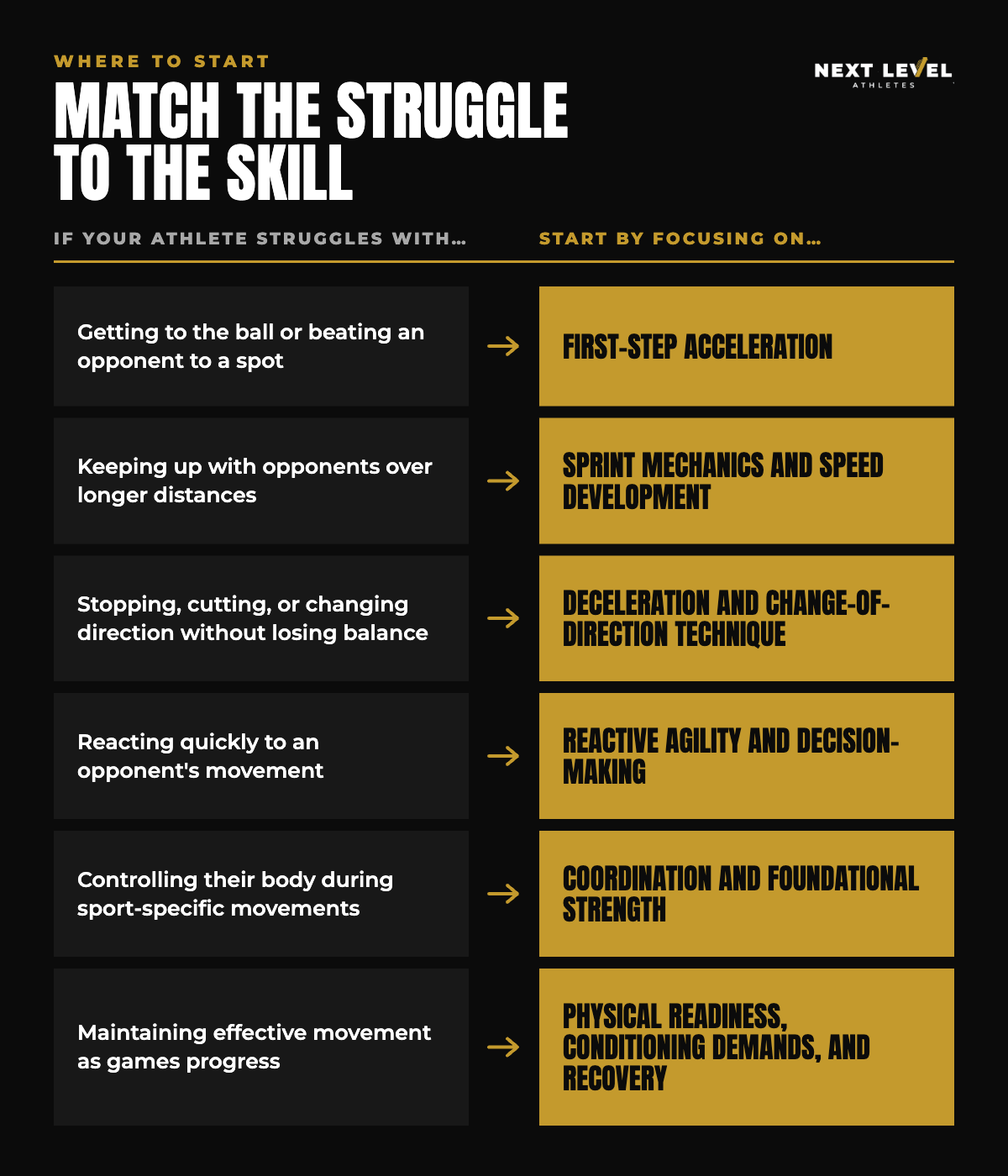
These are starting points, not diagnoses. An athlete who appears slow to react, for example, may need to improve their ability to read the game rather than their physical speed.
The important thing is to identify what's holding your athlete back and develop a plan that addresses it.
And remember, athleticism is only one part of the equation.
An athlete can be the fastest player on the field and still struggle because they lack the skills, game IQ, mentality, or habits to use that speed effectively.
The goal isn't just to develop a faster athlete. It's to develop a more complete athlete.
Is Team Practice Enough to Improve Your Athlete's Speed and Athleticism?
This is a question I get from sports parents all the time.
And my answer is that it depends on what the athlete is doing during practice.
Athletes absolutely develop physical abilities through playing their sports. A basketball player is constantly accelerating, jumping, and changing direction. A soccer player runs, reacts, and moves in different directions throughout a game.
But participating in those movements isn't the same as following a structured program designed to improve them.
A basketball coach might spend practice working on offensive sets, defensive rotations, and shooting. A football coach might focus on position techniques, assignments, and preparing for the next opponent.
Those are important parts of becoming a better player.
But how much time is actually spent teaching athletes how to accelerate more efficiently, develop strength, or improve their change-of-direction mechanics?
For many teams, the answer is not much.
And that's not a criticism of the coaches. They have a limited amount of practice time and an entire team to prepare.
It's simply the reality of team sports.
Team practice develops your athlete's ability to play the sport. Focused athletic development helps improve the physical tools they bring to that sport.
The two should work together.
When Should Youth Athletes Start Speed and Strength Training?
Another question parents ask is whether their athlete is too young to start working on speed and strength.
My perspective is that young athletes can begin developing athleticism early, but the training needs to match their age, maturity, experience, and ability.
For younger athletes, that means building a foundation through running, jumping, skipping, balance, coordination, and age-appropriate strength activities.
As athletes grow and develop, their training can become more structured and progressively challenging.
There's no single age when every athlete should begin the same program.
What matters is that they're learning proper technique, receiving appropriate supervision, and progressing at a pace that makes sense for them.
You don't need to rush the process.
A strong athletic foundation built over time will serve your athlete much better than trying to accelerate their development with advanced workouts they're not ready for.
The Bottom Line: Athleticism Is Something Your Athlete Can Develop
I've spent more than two decades helping athletes improve their physical performance, and one thing I want every sports parent to understand is that athleticism isn't just something you're born with.
Yes, genetics play a role. Some athletes are naturally faster, stronger, or more coordinated than others.
But that doesn't mean your athlete can't improve.
Speed can be trained. Strength can be developed. Change-of-direction technique can improve. Coordination and body control can be learned.
And those improvements can make a difference in how confidently and effectively your athlete competes.
The key is understanding where your athlete needs to improve and giving them the right opportunities to develop.
You don't need to do everything at once.
Start with one or two areas. Focus on proper technique. Be consistent. And give your athlete time to develop.
Because the goal isn't to turn your 10-year-old into a professional athlete tomorrow.
It's to help them continue building the athletic foundation they'll need as they grow, compete, and pursue their goals.
Every athlete has a next level. But getting there takes development, consistency, and the right work.